Movement Pattern · SQT
Squat Training:
Own the Ground Under You
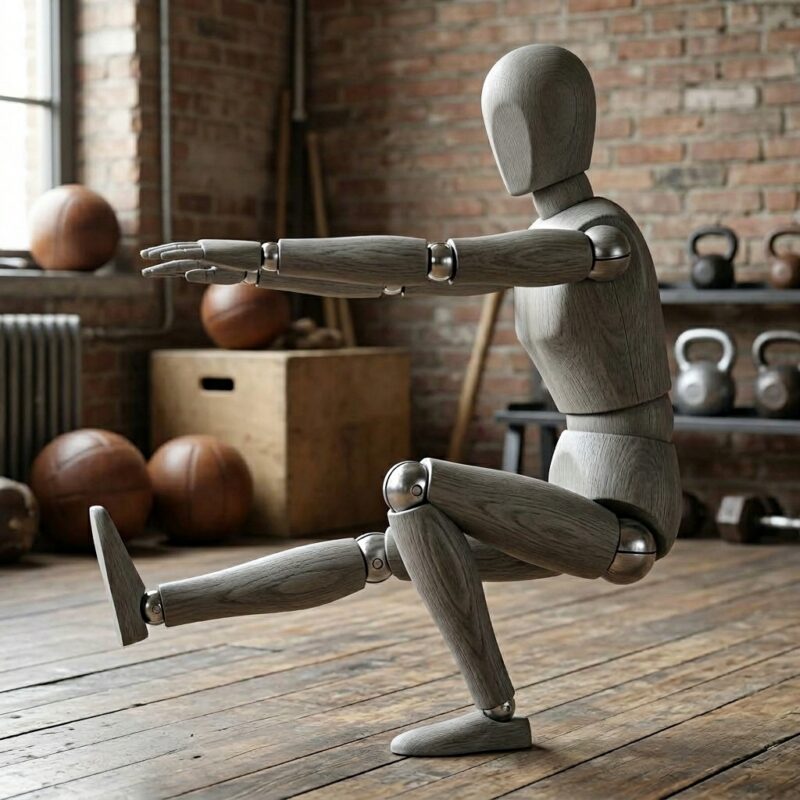
The squat is the most fundamental human movement pattern. It’s how we sit, stand, pick things up, and navigate the physical world. In calisthenics, squat training is also the path to one of the most impressive bodyweight skills: the pistol squat. This is the full library.
The Pattern
What Is a Squat Movement?
A squat movement is any exercise involving knee and hip flexion under load, lowering the body toward the ground and returning to standing. In calisthenics, that means working with bodyweight — through a range of stances, depths, tempos, and unilateral demands — rather than adding a barbell.
The bodyweight squat progression is uniquely honest. You can’t hide behind a belt or wraps. Your mobility, stability, ankle flexibility, hip range, and quad strength are all on display at once. That’s not intimidating — that’s information. Every limitation the squat reveals is a direct training signal.
Primary movers are your quadriceps, glutes, and hamstrings. Calves and hip flexors work as stabilizers. Ankle mobility is the most commonly limiting factor in squat depth — more than hip flexibility, more than quad strength. If your heels lift, your ankles need work before anything else.
Masters Note: For the 45+ practitioner returning to squatting after a long break, the most common mistake is loading too fast. The knee joint responds to load slowly — cartilage and connective tissue adapt over months, not weeks. Start with half-depth and earn your range progressively. Your joints will thank you for the next twenty years.
The Five Tiers
Squat Progressions: T1 → T5
The squat progression is the most mobility-dependent track in calisthenics. Ankle, hip, and thoracic mobility all intersect here. T1 and T2 are not throwaway steps — for many adults returning to movement, they’re where the real work happens.
T1 — Joint Prep
Mobility first
Ankle mobility work, hip circles, supported squat holds. Building the range the squat requires before loading it.
T2 — Load Introduction
Assisted squatting
Box squats, TRX-assisted squats, goblet squat position holds. Learning the pattern with support before going freestanding.
T3 — Skill Development
The bodyweight squat
Full squats, pause squats, tempo squats, jump squats. Building volume and positional awareness through range.
T4 — Strength
Unilateral entry
Bulgarian split squats, shrimp squats, assisted pistol squats. One-leg loading with support before the full movement.
T5 — Mastery
Pistol squat
Freestanding pistol squat and weighted pistol. Full unilateral bodyweight squat — one of the clearest signals of lower body mastery.
Full Library
Every Squat Exercise, Tiered
| Exercise | Tier | Primary focus |
|---|---|---|
| Ankle mobility drills | T1 | Dorsiflexion range, heel-to-wall test |
| Hip circles | T1 | Hip joint prep, range of motion |
| Supported squat hold (deep) | T1 | Bottom-position exposure, hip opening |
| Box squat | T2 | Depth limiter, sit-stand pattern |
| Assisted squat (TRX/pole) | T2 | Full depth with support, confidence building |
| Goblet squat hold | T2 | Counterbalance, thoracic upright position |
| Bodyweight squat | T3 | Full pattern, bilateral, full depth |
| Pause squat | T3 | Bottom tension, positional strength |
| Tempo squat | T3 | Eccentric control, time under tension |
| Jump squat | T3 | Power development, reactive strength |
| Split squat | T4 | Unilateral intro, hip flexor stretch |
| Bulgarian split squat | T4 | Rear foot elevated, unilateral load |
| Shrimp squat | T4 | Quad-dominant unilateral, balance demand |
| Assisted pistol squat | T4 | Full pistol pattern with support |
| Pistol squat | T5 | Freestanding unilateral full squat |
| Weighted pistol squat | T5 | Max unilateral lower body strength |
Programming
How to Train the Squat Pattern
Frequency: 2–3 squat sessions per week. Unlike push and pull, the squat pattern can be trained with slightly higher frequency because the movements are lower-skill and recovery is faster at T1–T3. Once you reach pistol squat work, treat it like any skill — 48-hour recovery minimum.
Mobility is the real workout at T1: For most adults who haven’t squatted in years, 10–15 minutes of ankle mobility work daily moves the needle faster than any squat variation. The heel-to-wall test is your benchmark — if you can’t get your knee 4+ inches past your toes without heel rise, ankle mobility is your current program.
The pistol squat timeline: Realistic expectations matter. For an adult starting from scratch, 6–12 months to a clean pistol squat is common. For someone with good mobility and existing leg strength, 3–6 months. For someone with limited ankle mobility starting out — longer. The pistol is one of the most satisfying skills in calisthenics precisely because of how much it requires. Every step in the progression is real training, not filler.
Knee health: Knees are load-tolerant joints — they’re designed for heavy, repeated use. But they adapt slowly. If knee discomfort appears, reduce depth before reducing frequency. Partial-range squatting is training. Full rest is not. Keep moving, keep the load honest.
Want to see where squat training fits in your full movement practice? The Progression Map shows all ten patterns — and exactly where you are in each one.
View the Progression Map →