Movement Pattern · PLL
Pull Training:
The Pattern That Changes Everything
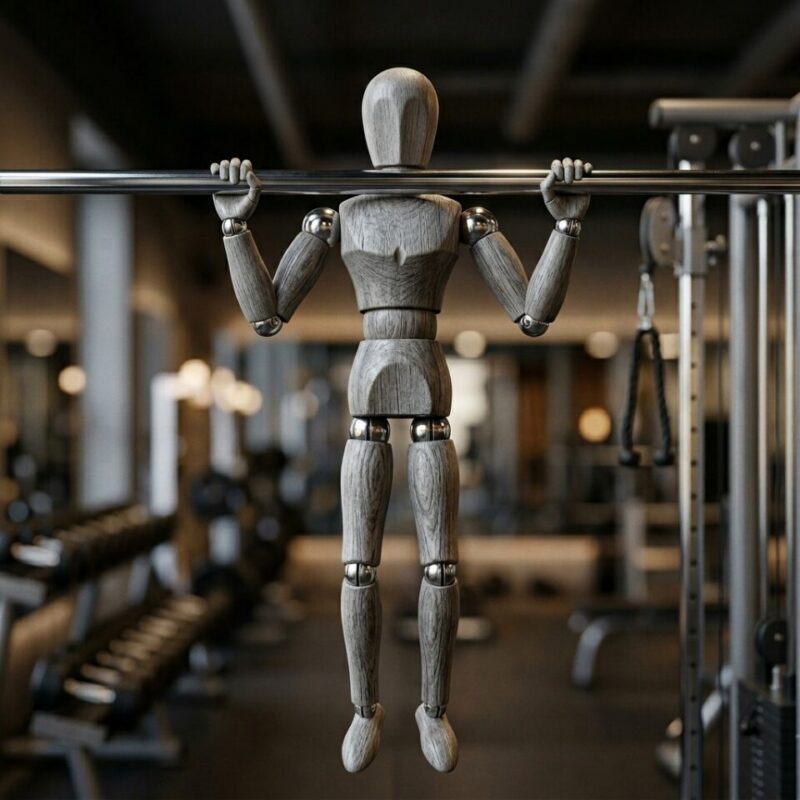
Pull movements are where calisthenics separates from the gym. The pull-up is the most honest test of relative strength there is — your bodyweight, your grip, nothing else. This is the full pull pattern library, from first hang to one-arm progressions.
The Pattern
What Is a Pull Movement?
A pull movement is any exercise where you move load or your own bodyweight toward your body through arm flexion. In calisthenics, that means hanging from a bar, rings, or any overhead structure — and pulling your bodyweight up to meet your hands.
Pull patterns divide into vertical pull (pull-ups, chin-ups — pulling from overhead) and horizontal pull (rows — pulling parallel to the ground). Both matter. Most people only train vertical. That’s a mistake — rows develop the mid-back and rear deltoids that vertical pulls don’t fully reach, and they’re essential for shoulder health in any serious push program.
Primary movers are your lats (latissimus dorsi), biceps, and rear deltoids. Rhomboids and mid-traps do the scapular work. A well-trained pull pattern is one of the clearest physical signals of real relative strength — and one of the most visible.
Masters Note: Elbow tendinopathy — both medial and lateral — is the most common injury for adults returning to pull training after a long break. It doesn’t announce itself loudly at first. It builds quietly over weeks of too much volume too fast, then sidelines you for months. The fix is preventive: build your dead hang time before your pull-up volume. Four weeks of hanging — dead hangs, scapular pull-ups, rows only — conditions the connective tissue that your muscles will outpace if you skip ahead. Your tendons are slower to adapt than your muscles. Respect that gap.
The Five Tiers
Pull Progressions: T1 → T5
Pull progressions are uniquely demanding because most people come in with almost no pulling history. The jump from dead hang to first pull-up is the most commonly underestimated gap in calisthenics. The tier system bridges it — if you actually use every step.
T1 — Joint Prep
Build the hang
Dead hangs, scapular retractions, shoulder circles. Grip and connective tissue conditioning before load.
T2 — Load Introduction
First pulling load
Vertical rows, incline rows, band-assisted pull-ups. Learning the movement pattern with manageable resistance.
T3 — Skill Development
The pull-up
Full pull-ups, chin-ups, neutral grip, wide grip. Building volume and consistency in the foundational movement.
T4 — Strength
Advanced load
Weighted pull-ups, L-sit pull-ups, ring pull-ups, typewriter pull-ups. Adding complexity and external load.
T5 — Mastery
One-arm work
One-arm negatives, archer pull-ups, muscle-up progressions. The long game. Patience required.
Full Library
Every Pull Exercise, Tiered
| Exercise | Tier | Primary focus |
|---|---|---|
| Dead hang | T1 | Grip strength, shoulder decompression |
| Scapular pull-ups | T1 | Lat activation, scapular control |
| Vertical rows (table rows) | T2 | Horizontal pull, bodyweight fraction |
| Incline rows | T2 | Progressive horizontal pull |
| Band-assisted pull-ups | T2 | Vertical pull pattern, reduced load |
| Negative pull-ups | T2 | Eccentric strength, vertical pattern |
| Chin-ups | T3 | Supinated grip, bicep emphasis |
| Pull-ups | T3 | Pronated grip, lat emphasis |
| Neutral grip pull-ups | T3 | Elbow-friendly, balanced load |
| Wide grip pull-ups | T3 | Lat width, reduced bicep involvement |
| Typewriter pull-ups | T4 | Lateral control, unilateral prep |
| L-sit pull-ups | T4 | Core integration, hip flexor demand |
| Ring pull-ups | T4 | Unstable surface, stabilizer demand |
| Weighted pull-ups | T4 | Max strength development |
| Archer pull-ups | T5 | Unilateral load introduction |
| One-arm negatives | T5 | One-arm pull-up prep |
| Muscle-up (bar) | T5 | Pull-to-push transition |
Programming
How to Train the Pull Pattern
Frequency: 2–3 pull sessions per week. Pull movements stress the elbow flexors and connective tissue heavily — elbow tendinopathy is the most common overuse injury in people who ramp pull volume too fast. Build slow.
Grease the groove: Pull strength responds exceptionally well to low-rep, high-frequency practice. If you have a bar at home, doing 2–3 pull-ups every time you walk past it — without going to failure — builds volume and neural efficiency faster than one weekly max-effort session.
The first pull-up: Most adults who have never done a pull-up need 6–12 weeks of T1 and T2 work before attempting a full rep. That’s dead hangs, scapular pull-ups, rows, and negatives — consistently, every week. The pull-up doesn’t arrive without that foundation. With it, it shows up on a specific, identifiable day.
Balance with push: Match pull sessions with push sessions across the week. The ratio that protects shoulder health long-term is roughly equal push and pull volume — or slightly more pull. If your shoulders ache during push movements, add more rowing before adding more push exercises.
Ready to find your place in the pull progression? The Progression Map shows where you are across all ten movement patterns — and what comes next.
View the Progression Map →